A reporter’s phone and the identity behind the photograph
Monolith Technologies FZCO · · 6 min read
A source photograph between assignments
The photograph shows an empty office corridor. Its significance lies in the message that arrived with it, a source’s explanation of who met there and when. A reporter saves the image while travelling to an interview. Later, at a community event, someone asks to see photographs from an unrelated story. The handset is now a place where a public professional role and a confidential source relationship could meet in a single gallery.
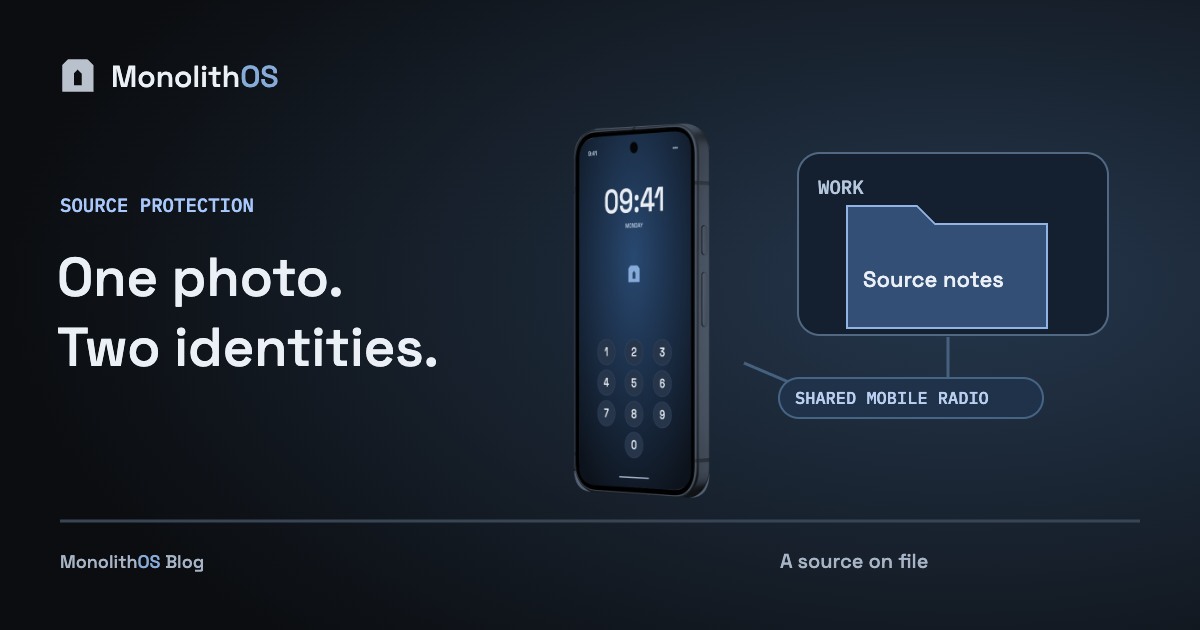
The reporter in this illustrative story uses MonolithOS. Public carries ordinary correspondence, event photographs and the accounts used for visible reporting. Work holds the separate source account, interview notes and privately received images. The same Pixel serves both roles, with distinct application data, galleries and local files. That arrangement addresses a specific part of source privacy, how a confidential relationship is represented on the device when the reporter is using it for something else.
The source relationship is a collection of small records
A source can be identifiable through more than the message itself. A contact entry, an attachment filename, a recent conversation or a photograph beside another photograph can supply context. For a reporter working across several stories, those details accumulate quickly. Some belong in ordinary professional life. Others belong to a relationship that needs a private local space.
MonolithOS lets the reporter put the source identity in Work, along with the applications and files that support it. Public holds the everyday role. The operating system uses separate Android user environments, so Work’s app data and locally stored records have their own context. A messenger installed in both environments can have separate accounts and histories. The reporter can therefore maintain a private source identity on the same handset as the public-facing professional one. The separation reaches the local records around the conversation, which is where incidental exposure can occur during normal use.
The photograph stays with the environment that received it
The corridor image arrives in the Work account and is saved in Work. It appears in Work’s gallery. When the reporter opens Public at the community event, Public’s gallery shows its own photographs. The source image belongs to the other environment. This gives the reporter a straightforward way to show ordinary material without bringing the private collection into the same browsing session.
The same boundary applies to interview notes and downloaded documents. An app opened in Public operates within Public’s local data, while the Work account and files live in Work. This makes the phone’s organisation match the reporter’s roles. The event photographs are available where they are needed. The source material is available in the private environment when the reporter returns to that story. MonolithOS supplies a durable local distinction across several apps, allowing the confidential relationship to remain together instead of being scattered through the everyday workspace.
Discreet access matters between assignments
The reporter uses the same lock screen for Public and Work. A PIN determines which environment opens. Public has no Work switcher in the lock screen, Quick Settings or Settings, and Work’s recent applications and usage activity stay out of Public. Work notifications are not forwarded into the everyday environment. These are useful details when the phone is used constantly around other people.
At the community event, the reporter can open Public to find a contact, photograph or event message without navigating past the source identity. During the private interview later, the Work PIN opens the environment used for that relationship. The architecture makes those roles distinct while keeping the handset familiar to use. This is where MonolithOS’s product value becomes tangible for a journalist, the private workspace has a separate place on the device, and ordinary interactions in Public stay within the local context of the public-facing role.
A private call, a closed session and the next check-in
The source calls while the reporter is walking away from the venue. The conversation uses a calling app in Work. Pressing Power turns off the screen while the call continues. MonolithOS supports this behavior for Work calling apps, so the reporter can put the phone away during the conversation. Power does not end the Work call.
If the device remains locked, Work closes after the call ends. Outside an active call, the Power button, screen timeout and Close Work control provide ways to close the private environment. Work’s apps stop, and closure finishes once their local files are locked again. This gives the conversation a practical lifecycle. The source identity is active in Work while the reporter is using it, and the environment can return to a closed state afterward. The behavior connects privacy with the basic requirement that a phone conversation should continue when the screen is no longer needed.
Later that evening, the reporter closes Work and returns to Public. Work’s applications are stopped while the environment is closed. A new source message arrives in the Work app when the reporter next opens Work and the app reconnects. Public continues to serve ordinary communication without forwarding the private environment’s alerts.
This is a specific form of control over the working day. The source relationship has its own account and local records, and its app session has a deliberate boundary. The reporter can open Work to return to the conversation and close it when finished. The product keeps that choice at the environment level, covering the source messenger, notes and files together. For a journalist handling several roles on one phone, the value is the coherence of the private space. The source account is one part of a complete Work environment whose active and closed states are understandable.
Separate local identities answer a precise tracking question
A source story can be connected to the reporter through records visible on the handset. MonolithOS addresses that local exposure by keeping Work’s accounts, app history, photographs and files outside Public. Opening the everyday environment therefore presents the records of that environment. That is the tracking-related benefit the architecture can explain directly, fewer confidential local relationships appearing in ordinary Public use.
Both environments still belong to one physical handset and use its connectivity. The separation concerns local user environments and their data. It does not create a second physical radio or remove records held by a communications service. This scope helps explain the product accurately without blurring different kinds of privacy. The reporter gains a separate local home for source work, with private access and session closure, while the public-facing role remains usable on the same Pixel. That is a substantial, specific improvement to the way confidential reporting material is organised and accessed on the device.
The reporting day ends with a private space that can close
Back at the desk, the reporter opens Work to organise the interview notes and source photograph. New Work applications start with Network and Sensors off, so a local document tool can begin with those restricted defaults. The source account and working files remain together in the private environment. When the task is finished, Work closes with its apps stopped and local files locked again.
If the handset is subsequently lost, MonolithOS’s built-in management and Client Portal provide Remove Work and factory-reset commands, with remote execution requiring a device connection. These actions extend the same owner control beyond the current session. The product’s relevance to reporting runs through the whole day, receiving a source message, showing unrelated photographs in Public, taking a private call and closing the source workspace afterward. MonolithOS gives the reporter one phone with distinct places for the visible professional role and the confidential relationships behind the work.